mandag den 1. februar 2016

Homebrew: Psionic Elemental Monk

CLASS TRAITS
Role: Striker.
Power Source: Psionic.
Key Abilities: Dexterity, Strength, Constitution, Wisdom, Charisma

Armor Proficiencies: Cloth.
Weapon Proficiencies: Club, dagger, monk unarmed strike, quarterstaff, shuriken, sling, spear.
Implement: Ki focuses, weapons with which you're proficient
Bonus to Defense: +1 Fortitude, +1 Reflex, +1 Will.

Hit Points at 1st Level: 12+ Constitution Score.
Hit Points per Level Gained: 5
Healing Surges per Day: 7+ Constitution Modifier.

Trained Skills: From the class skills list below, choose 4 trained skills at 1st level.
Class Skills: Acrobatics (Dex), Athletics (Str), Diplomacy (Cha), Endurance (Con), Heal (Wis), Insight (Wis), Perception (Wis), Religion (Int), Stealth (Dex), Thievery (Dex).

Build Options: Air Monk, Earth Monk, Fire Monk, Water Monk.
Class features: Elemental Tradition, Psionic Augmentation, Unarmed Combatant, Unarmored Defense.

MONK CLASS FEATURES
ELEMENTAL TRADITION
Monks train in a number of traditional techniques, with each monastery focusing on a specific style. Choose one of the four elements as your tradition. The choice you make grants you a Flurry of Blows power, a defensive benefit and an encounter power.
  • Air
    • Flurry of Blows: You gain the centered flurry of blows power.
    • Mental Equilibrium: You gain a +1 bonus to Fortitude. This bonus increases to +2 at 11th level and +3 at 21st level.
    • Elemental Escalation: You gain elemental escalation (air monk).
  • Earth
    • Flurry of Blows: You gain the stone fist flurry of blows power, except you use your Constitution modifier instead of your Strength modifier.
    • Mental Bastion: You gain a +1 bonus to Will. This bonus increases to +2 at 11th level and +3 at 21st level.
    • Elemental Escalation: You gain elemental escalation (earth monk).
  • Fire
    • Flurry of Blows: You gain the desert wind flurry of blows power.
    • Mental Crucible: You gain resist 5 fire. The resistance increases to 10 at 11th level and 15 at 21st level. If you already have fire resistance that is equal to or higher than this value, increase it by 2 (4 at 11th level and 6 at 21st level).
    • Elemental Escalation: You gain elemental escalation (fire monk).
  • Water
    • Flurry of Blows: You gain the eternal tide flurry of blows power.
    • Mental Balance: Whenever an enemy would pull, push, or slide you, you can reduce the forced movement by 1 square. After the forced movement is resolved, you can shift 1 square as a free action.
    • Elemental Escalation: You gain elemental escalation (water monk).


PSIONIC AUGMENTATION
At-Will Attack Powers: At 1st level, you choose two at-will attack powers and one daily attack power from your class, but you don’t start with any encounter attack powers from your class except for the elemental escalation power you gain as part of your tradition. You instead gain power points, which you can spend to use and augment your elemental escalation power, as well as augment certain powers from paragon paths and multiclassing. These powers have the augmentable keyword.

Master of Many Styles: You gain new at-will attack powers from this class, instead of new encounter attack powers, as you increase in level. At 3rd, 13rd and 23th level, you choose a new at-will attack power from this class, or from the sorcerer class. The at-will powers normally only available to an elementalist (sorcerer) are available at level 7. If you choose to gain a power from the sorcerer class this way, replace all Charisma modifiers with Dexterity modifiers, replace all Constitution modifiers with the ability score modifier you use for determining the damage of your flurry of blows power, and the power loses the arcane keyword and gains the psionic keyword. At 7th, 17th, and 27th level, you can replace one of your at-will attack powers with another one of your level or lower. Both the replaced power and its replacement must be from this class feature.

Power Points: You start with 2 power points. You gain 2 additional power points at 3rd and 7th level, 1 additional power point at 13th level, and 2 additional power points at 17th, 21st, 23rd, and 27th level. If you gain power points from another source (such as your paragon path), add them to your power point total. You can use your power points to augment any augmentable power you have, regardless of how you gained the power.

You regain all your power points when you take a short or an extended rest.

Level
At-Will Attack Powers
Power Points
1
Choose two
Gain 2
3
Choose one
Gain 2 (4 total)
7
Replace one
Gain 2 (6 total)
13
Choose one
Gain 1 (7 total)
17
Replace one
Gain 2 (9 total)
21
Gain 2 (11 total)
23
Choose one
Gain 2 (13 total)
27
Replace one
Gain 2 (15 total)

UNARMED COMBATANT
You can make unarmed attacks with much greater effectiveness than most combatants can. When you make a weapon attack such as a melee basic attack, you can use the monk unarmed strike, which is a weapon in the unarmed weapon group. This weapon has the off-hand weapon property and a +3 proficiency bonus, and it deals 1d8 damage. You must have a hand free to use your monk unarmed strike, even if you’re kicking, kneeing, elbowing, or head-butting a target. Also, your monk unarmed strike can benefit from a magic ki focus if you have one (see “Implements” below).

UNARMORED DEFENSE
While you are wearing cloth armor or no armor and aren’t using a shield, you gain a +2 bonus to AC.

Full Discipline
Many monk powers have the full discipline keyword. A full discipline power gives you two or more actions to choose from, usually an attack technique and a movement technique. Attack techniques usually require a standard action, and movement techniques are options for your move actions. For a monk, a full discipline power represents a fighting style, a unique combination of a move and an attack.
You can use only one full discipline power per round. However, if you spend an action point to take an extra action, you can switch to a different full discipline power. You can use the techniques of a full discipline power in whatever order you like, and you can choose to use one of the techniques and not the other during a particular round.
The number of times you can use a full discipline power’s techniques during a round is determined by the power’s type—at-will or encounter—and by the actions you have available that round. For example, you can use the techniques of an at-will full discipline power as many times during a round as you like, provided you have enough of the required actions, but you can use the techniques of an encounter full discipline power once during a round. 

IMPLEMENTS
Monks usually channel their psionic energy through an item called a ki focus, which is a wooden practice weapon, prayer beads, a manual of lore, or some other object a monk studies or uses during training or meditation. After you attune yourself to a ki focus, you can use it as an implement when it is on your person (see the “Ki Focuses” sidebar).

When you wear or hold your ki focus, you can add its enhancement bonus to the attack rolls and the damage rolls of monk powers and monk paragon path powers that have the implement keyword. You can also add its enhancement bonus to the attack rolls and the damage rolls of weapon attacks you make using a weapon with which you’re proficient.

You can also use a weapon with which you’re proficient as an implement. When wielding the weapon as an implement, the weapon’s characteristics—proficiency bonus, damage die, and weapon properties like defensive or high crit—are irrelevant to your implement powers.

If you have both a magic ki focus and a magic weapon, you choose before you use an attack power whether to draw on the magic of the ki focus or the weapon. Your choice determines which enhancement bonus, critical hit effects, and magic item properties and powers you can apply to that power. You can’t, for example, use the enhancement bonus of your ki focus and the critical hit effect of your magic weapon with the same attack.

Homebrew: Necromancer

CLASS TRAITS
Role: Controller. 
Power Source: Arcane. 
Key Abilities: Intelligence; Constitution

Armor Proficiencies: Cloth.
Weapon Proficiencies: Dagger, quarterstaff.
Implement: Orbs, staffs, wands
Bonus to Defense: +2 Will.

Hit Points at 1st Level: 10+ Constitution Score.
Hit Points per Level Gained: 4
Healing Surges per Day: 6+ Constitution Modifier.

Trained Skills: Arcana. From the class skills list below, choose 3 more trained skills at 1st level.
Class Skills: Arcana (Int), Diplomacy (Cha), Dungeoneering (Wis), History (Int), Insight (Wis), Nature (Wis), Religion (Int).

Class features: Curse of Undeath, Unholy Might, Necromancer's Spellbook, Necromancer Cantrips.


A necromancer is a wizard specialized in the dark arts of raising and controlling dead corpses. While a mage specialized in the necromancy school might come close to harnessing this power, a necromancer focuses on the creation of undead rather than the use of necromancy in regular spells.
    Although necromancy has a bad reputation, as the very word conjures up pictures of villains and evil masterminds hellbent on taking over or destroying the world, not all necromancers are so. A few of those that study the arts of raising the dead and commanding them to do one's bidding travel the land as any other adventurer might - but with the added company of walking dead. Such a wizard lacks the flexibility and focus that an arcanist or mage might have, but makes up for it either by sending large numbers of undead towards their foes, or by crafting a single powerful servant to aid them.
    Few schools teach necromancy openly, and fewer still train young apprentices in the arts with which to conjure up the dead, so most necromancers are either self-taught, trained by a single master with maybe a few other students, or a combination of the two. Some necromancers are wizards who found forbidden tomes in ancient tombs, or adventurers who turned apprentice once they discovered sympathy for the necromancer they were tasked to destroy. Still, necromancers are a competitive bunch, and most will do anything to gain new power as well as to protect that which they already have.
    Necromancers are scattered across the continents, and few such practitioners of the dark arts ever meet. Some necromancers band together in city guilds or cults to Vecna or Orcus, but most travel the world without meeting another of their kind very often. Settlements with large graveyards, or those close to ancient battlefields or natural crossings to the Shadowfell, are where most necromancers are found nowadays.


WIZARD (NECROMANCER) CLASS FEATURES

CURSE OF UNDEATH
You gain resist 5 necrotic per tier.
As a necromancer, you can either focus on amassing hordes of undead minions, or to focus your powers on creating a single undead champion. Choose one of the following class features:
  • Horde Necromancer: You gain the Raise Minion and Undead Minion Attack powers.
    • Raise Minion
      • Raise Minion
      • Wizard Utility
      • You beckon to the corpse in front of you, and it rises to obey your commands.
      • At-Will
      • Arcane, Necromancy, Shadow
      • Move Action
      • Ranged 10
      • Target: One suitable corpse
      • Effect: The target rises as an undead minion under your control, and it moves or shifts as a free action.
      • Special: You can use this power only once per round.
    • Undead Minion Attack
      • Undead Minion Attack
      • Wizard Utility
      • At-Will
      • Arcane, Implement, Necromancy, Shadow
      • Standard Action
      • Close burst sight
      • Target: One creature adjacent to each of your undead minions.
      • Attack: Intelligence vs. AC (one attack for each of your undead minions)
      • Hit: Intelligence modifier damage. If a single target is hit by two or more of these attacks, that target is slowed until the end of your next turn.
      • Level 21: Twice Intelligence modifier damage. If a single target is hit by two or more of these attacks, that target is immobilized until the end of your next turn. If a single target is hit by three or more of these attacks, that target is instead restrained.
      • Special: If the implement used with this power has an enhancement bonus, add that bonus to the damage.
    • A suitable corpse is medium or smaller.
    • Your undead minions do not have senses of their own; instead, you must have line of sight to a creature or object for one of your undead minions to attack it. You need not have line of effect to the target.
    • Your undead minions do not have turns of their own. Your undead minions cannot make attacks of opportunity.
    • Your undead minions are creatures, but do not count as allies for your allies, although they can be used to flank with each other.
    • Your close and area arcane attack powers deal no damage to your undead minions.
    • You can have a maximum of 2 undead minions. If you control your maximum amount of undead and you use this power, one of your older undead minions crumbles and dies.
    • As a standard action, you can command each undead minion you are controlling to make a basic attack.
    • As a minor action, you can command each undead minion you are controlling to either walk, shift, stand up, squeeze, or crawl.
    • Each of your undead minions has your skills, speed and defenses, and a single hit point, and reducing it to 0 hit points destroys it. Your undead minions cannot be healed, but can gain temporary hit points as normal.
    • Your undead minions are immune to disease and poison.
  • Champion Necromancer: You gain the Raise Champion and Undead Champion Attack powers.
    • Raise Champion
      • Raise Champion
      • Wizard Utility
      • You beckon to the corpse in front of you, and it rises to do your dark bidding.
      • Encounter
      • Arcane, Necromancy, Shadow
      • Standard Action
      • Ranged 10
      • Requirement: You must use this power during a short or extended rest. You must have at least one healing surge remaining.
      • Target: One suitable corpse
      • Effect: The target rises as an undead champion under your control. You lose one healing surge.
    • Undead Champion Attack
      • Undead Champion Attack
      • Wizard Utility
      • At-Will
      • Arcane, Champion, Necromancy, Shadow
      • Standard Action
      • Melee weapon (using your champion as the origin square)
      • Target: One creature
      • Attack: Intelligence vs. AC
      • Hit: 1d8 + Intelligence modifier damage.
      • Level 21: 2d8 + Intelligence modifier damage.
      • Special: If your champion is wielding a weapon with which it is proficient, replace each d8 with [W] and this attack gains the mundane weapon qualities of that weapon.
      • Special: You can use this power as an opportunity attack.
    • A suitable corpse is medium or smaller.
    • Your undead champion does not have senses of its own; instead, you must have line of sight to a creature or object for your champion to attack it. You need not have line of effect to the target.
    • Your undead champion does not have turns of its own.
    • Your undead champion has weapon slots for both hands, but does not benefit from carrying a shield.
    • Your undead champion is a creature but does not count as an ally for your allies, but you can use it to flank, and your champion can use you and your allies to flank.
    • Your close and area arcane attack powers deal no damage to your undead champion.
    • You can have only a single undead champion. If you already control an undead champion when you use this power, your old champion crumbles and dies.
    • Your undead champion has your skills, speed and defenses, and hit points equal to your bloodied value. Your undead champion has no healing surges of its own, but if it would be allowed to spend a healing surge, you can spend one to allow it to regain hit points instead.
    • Your champion is immune to disease and poison.
    • Your champion has resist 10 necrotic. This increases to 15 at 11th level and 20 at 21st level.
    • Your champion has vulnerable 5 radiant. This increases to 10 at 11th level and 15 at 21st level.
    • Champion keyword:
      • Attacks with the champion keyword are made by your champion.
      • If your champion wields a magic weapon, you can add its enhancement bonus to the attack rolls and the damage rolls of champion attacks you make. If you have both a magic champion weapon and a magic implement, you choose before you use an attack power whether to draw on the magic of the implement or that of the champion weapon. Your choice determines which enhancement bonus, critical hit effects, and magic item properties and powers you can apply to that power. You can’t, for example, use the enhancement bonus of your implement and the critical hit effect of your magic champion weapon on the same attack.
    • Each time you use your Raise Champion power, choose one of the following templates for your undead champion:
      • Monstrosity: Your champion grows in strength and ferocity. A suitable corpse is large or smaller. Whenever your champion hits with an attack, it deals extra damage equal to your constitution modifier. Your champion is proficient with all simple melee weapons.
      • Guardian: Your champion grows in durability and vigilance. Whenever your champion attacks a creature, it marks that creature until the end of its next turn. Your champion gains a +1 bonus per tier to all defenses, and resist all damage equal to your constitution modifier. Your champion is proficient with all simple and military weapons.
      • Spectral: Your champion becomes ghostly. Your champion is incorporeal and gains phasing and a fly speed equal to your speed, but its hit points are reduced to two-thirds of your bloodied value. Whenever your champion hits with an attack while it has combat advantage, it deals extra damage equal to your constitution modifier. Your champion is proficient with all simple weapons.

UNHOLY MIGHT
At the levels below, you gain a class feature according to the choice you made for your curse of undeath.
Level
Horde
Champion
7
Growing Horde: You can now have a maximum of 3 undead minions.
Whenever you use an encounter attack power that has a level, each of your undead minions can shift 2 squares as a free action.
Speed of the Dead: Whenever you use an encounter attack power that has a level, your champion can shift its speed as a free action.
11
Quick Reanimation: You can now use Raise Minion as a minor action.
Reliable Champion: Your allies can now use your champion to flank.
15
Paragon Hordemaster: You can now have a maximum of 4 undead minions.
Your undead minions gain their own senses and darkvision. You and your undead minions share all senses.
Paragon Champion: Your champion gains its own senses and darkvision. You and your champion share all senses.
Monstrosity: Your champion gains an unarmed reach of 2. Your champion is now also proficient with all military weapons.
Guardian: Whenever your champion hits a creature, that creature is immobilized until the end of your next turn. Your champion is now also proficient with all superior weapons.
Spectral: At the end of each of your turns, if your champion did not attack this turn, it becomes invisible until it attacks. Your champion is now also proficient with all military weapons.
18
Resilient Horde: When one of your undead minions dies, you can attempt to reanimate it as an immediate reaction. If you do so, make a saving throw. If you succeed, your undead minion stands up as a free action with 1 hit point.
Vigilant Champion: Your champion can make an opportunity attack once per combatant's turn while you are unable to take opportunity actions because of a condition. If your champion has made an opportunity attack this turn, you cannot take other opportunity actions.
22
Epic Hordemaster: You can now have a maximum of 5 undead minions.
Whenever one of your undead minions dies, its corpse can be used later as a target for your Raise Minions power.
Resilient Champion: At the end of your turn, end all effects on your undead champion.
As long as you have line of sight and effect to your champion, you can use your powers using its space as the origin square.
25
Improved Resilient Horde: If you fail a saving throw made from your Resilient Horde class feature, you regain the use of an immediate action this round.
Improved Vigilant Champion: Your champion has its own opportunity action during each combatant's turn, whether or not you are able to take opportunity actions.
29
Ultimate Hordemaster: You can now have a maximum of 6 undead minions.
You can now Raise Minion to target an amount of suitable corpses equal to your maximum amount of undead minions.
Epic Champion:
Monstrosity: A suitable corpse is huge or smaller. Your champion gains threatening reach. Whenever your champion hits a creature, that creature takes ongoing 10 damage (save ends).
Guardian: A suitable corpse is large or smaller. Whenever your champion hits a creature, you can choose for that creature to be restrained instead of immobilized for the duration of the effect.
Spectral: A suitable corpse is large or smaller. Whenever your champion makes an attack, that attack is against the lowest of the target's defenses instead of against AC.


NECROMANCER'S SPELLBOOK
As you gain levels, you add spells to your spellbook according to the Spells Added To Spellbook table below.
    At the end of each of your extended rests, you can prepare encounter attack powers, daily attack powers, and utility powers from your spellbook. These are the powers that you can use during that day, in addition to your at-will attack powers, cantrips, and nonwizard powers, such as a racial power. If you do not prepare powers from your spellbook after an extended rest (for example, if you do not have access to your spellbook), you can use the same powers you had prepared on the previous day.
    Find your level on the Spells Prepared per Day table. The row corresponding to your level indicates how many encounter attack powers, daily attack powers, and utility powers you are allowed to prepare each day. You cannot prepare more than one encounter attack power, daily attack power, or utility power of any given level on the same day. For example, a 14th-level necromancer can prepare three encounter attack powers per day. Her spellbook contains multiple encounter attack powers at various levels. She can prepare three powers from any of the levels, as long as none of the prepared powers are of the same level.

SPELLS ADDED TO SPELLBOOK

Level
Encounter
Daily
Utility
1
1
2
2, 6, 10, 16, 22
2
3, 7, 13, 17, 23, 27
1
5, 9, 15, 19, 25, 29
2

SPELLS PREPARED PER DAY

Level
Encounter
Daily
Utility
1
1
1
2
1
1
1
3-4
2
1
1
5
2
2
1
6
2
2
2
7-8
3
2
2
9
3
3
2
10-15
3
3
3
16-21
3
3
4
22-30
3
3
5


NECROMANCER'S CANTRIPS
Your gain two wizard cantrips of your choice.

MAGIC MISSILE
You gain the magic missile power.

Homebrew: Arcane Archer

Arcane Archer (Ranger Variant)

Requirement: Ranger or Hunter (Ranger)

Changes:

  • Power Source: Arcane and Martial
  • Ranger Tradition: Choose between Hunter features (including stances, wilderness knacks and pre-selected at-will attack powers) or Ranger features (fighting style, daily attack powers and choice of at-wills powers).
  • Skills: Add Arcana to the list of skills you can choose to gain training in.
  • Arcane Studies: Your gain a spellbook which holds your utility powers (and rituals, if you are able to master rituals).
    • You cannot choose Ranger utility powers with the Primal keyword.
    • When choosing utility powers, you can choose powers from the Wizard class and you can choose two utility powers instead of one.
    • After each extended rest, you prepare only one utility power from each level of utility powers that you have gained (2, 6, 10, 16, 20 and 22). You cannot use unprepared utility powers that you have gained through leveling up as a Ranger. If you replace a utility power gained this way with another (for example by multiclassing), the new power is also added to your spellbook.
    • Utility powers gained through other means (such as themes or feats) are not added to your spellbook, and you can use them without preparing them.
    • You ignore the INT requirement needed for taking Wizard multiclass feats.
  • Magic Arrows: Instead of gaining encounter attack powers (including Disrupting Shot) from your class, you instead gain the ability to convert regular ammunition into magical ammunition of a new type.
    • Each time you would gain a new encounter attack power (or another use of Disrupting Shot) or replace an existing encounter attack power with one of a higher level, you instead learn how to make a new type of magical ammunition of your level + 2 or lower.
    • Converting a single piece of ammunition into magical ammunition is a free action and requires you to spend an arcane point for each +1 of the ammunition. For example, using the Twin Strike power and converting two arrows into a +1 Freezing Arrow and a +4 Firestorm Arrow requires you to spend 5 arcane points.
    • The highest level of ammunition you can create in this way is equal to your level + 2.
    • Magical ammunition created in this way loses its magic properties after having been used.
    • Overview of new types of Magic Arrows:
  • Level
    Total types of Magic Arrows (Expanded Arcana)
    1-2
    1
    3-6
    2
    7-10
    3
    11-12
    3 (4)
    13-16
    4 (5)
    17-22
    5 (6)
    23-26
    6 (7)
    27-30
    7 (8)
      • Special: The zone created by Shadowshaft Ammunition created by this power only lasts until the end of your next turn.
  • Arcane Pool: You have a pool of arcane points.
    • You regain all spent arcane points during a short rest.
    • Overview of arcane points pool:
  • Level
    Arcane Points Pool (Expanded Arcana)
    1-2
    1
    3-5
    2
    6
    4
    7-10
    6
    11-15
    9 (12)
    16-20
    12 (16)
    21-25
    15 (20)
    26-30
    18 (24)
  • Conjure Ammunition: Instead of taking the action to load a ranged weapon, you can use that action to conjure a piece of ammunition already loaded in the weapon that lasts until used. You can choose for the conjured ammunition to be a type of magical ammunition that you know how to create by spending arcane points as if you were converting regular ammunition into magical ammunition.
  • (Optional) Expanded Arcana: When you reach level 11, if you would gain an encounter attack power from your Paragon Path, you can choose to forego gaining that power in order to gain the Expanded Arcana feature. If you would have gained another use of Disrupting Shot at level 11, you also gain the Expanded Arcana feature.
    • Expanded Arcana: At level 11, you learn how to make a new type of magical ammunition, and your pool of arcane points increases.


          Psionic variant:

          • Power Source: Psionic and Martial
          • Psionic Studies: As the Arcane Studies feature, except you do not gain a spellbook, and you can choose utility powers from the Psion class instead of the Wizard class. You also gain 1 power point, which can be used for certain powers (noted in the power itself). Instead of ignoring the INT requirement for Wizard multiclass feats, you ignore the INT requirement for Psion multiclass feats.

          Se en liste over magisk ammunition her: http://hnsdnd.blogspot.dk/2016/02/oversigt-magisk-ammunition.html
          Husk at alle magiske genstande får et ekstra +1 for hvert 5. level - så Surprise Ammunition starter med +1 på level 3, og bliver +2 på level 8, +3 på level 13, etc.

                Homebrew: Grafter Paragon Path

                Grafter

                • You combine the magic of grafting with the power of your soul. Like an artificer channels power through magical devices, you channel power through various parts of your body. While another person with a graft 
                • Prerequisite: Mage (Wizard), Apprentice Grafter feat
                • Power of Incarnum (11th level): Each time you would add two encounter powers to your spellbook, you only add a single encounter power instead, and you gain an incarnum slot of the corresponding level. After each extended rest, when you prepare your Wizard powers, you can choose to prepare incarnum powers in place of one of more encounter powers. Each graft can only be used to prepare a single power this way, and you cannot prepare an incarnum power of a given level if you prepare another incarnum or wizard encounter power of the same level. If an incarnum power lists different characteristics based on level and/or a tier, those characteristics depend on the level of the incarnum slot you used to prepare the incarnum power, not your level or tier.
                • Fleshwarper (11th level): You can equip a total of two minor grafts. You gain a 11th level incarnum slot.
                • The Flesh is Strong (11th level): When you spend an action point to take an extra action, you gain temporary hit points equal to 10 + half your level.
                • Adept of the Flesh (12th level): You can equip a total of three minor grafts.
                • Incarnum Prodigy (12th level): You can now also prepare incarnum utility powers and you gain a 12th level incarnum slot that can only be used to prepare incarnum utility powers. This follows the rules for preparing incarnum encounter attack powers, except for the following:
                  • When you gain a level and add utility powers to your spellbook, you don't add fewer powers than normally.
                  • For some incarnum utility powers when you prepare it, you can choose its frequency (at-will, encounter or daily). If a graft has multiple frequencies available for its incarnum utility powers, those are listed in the graft's power list.
                • Master of the Flesh (16th level): You can equip a total of three minor grafts and one major graft.
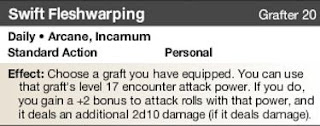
                • Swift Fleshwarping (20th level): You gain the swift fleshwarping daily power.

                Tilhørende regler

                Alle karakterer har et enkelt item slot, som enten kan bruges til at indeholde en symbiont eller et graft. Disse grafts er dog ofte begrænsede i hvad de kan gøre, og har ofte store penalties (fx -2 til AC/Fortitude, -5 Diplomacy, eller færre healing surges end normalt).

                Derudover kan der findes visse graft-lignende items, som imiterer almindelige magiske genstande. Man kan fx finde ekstra øjne, som kan sættes på hovedet, og som giver en bonus til Perception - disse ville tælle som almindelige magic items når det kommer til item slots.

                Hvis man tager featet Apprentice Grafter, har man adgang til at equippe et enkelt graft uden penalties som et "minor graft". Tager man Grafter som Paragon Path, åbner det op for yderligere minor graft slots, og på level 16 for muligheden for at få et enkelt major graft. Et minor graft er ca. lige så stærkt som et feat, og et major graft er ca. lige så stærkt som en level 16 Paragon Path feature (eller et Paragon/Epic tier feat).

                Når man tager den ovenstående Grafter Paragon Path, har man ikke længere adgang til det graft "item slot", som man havde indtil da, i samme grad som tidligere: Nogle grafts har både stats som minor/major grafts og almindelige grafts, og disse vil kun kunne bruges som minor/major grafts.

                Homebrew Feat: Apprentice Grafter
                • Prerequisite: 6th level, Con 15, training in the heal skill
                • Benefit:
                  • You can equip a single minor graft. Each graft has different statistics based on whether it is equipped as a minor or major graft.
                  • A graft can only be equipped or unequipped during an extended rest, and after that rest, you regain 1 fewer healing surge for each graft you equipped or unequipped this way. If you unequip a graft this way and replace it with a body part of the same type that does not grant a bonus, the replacement doesn't cause you to lose an additional healing surge.